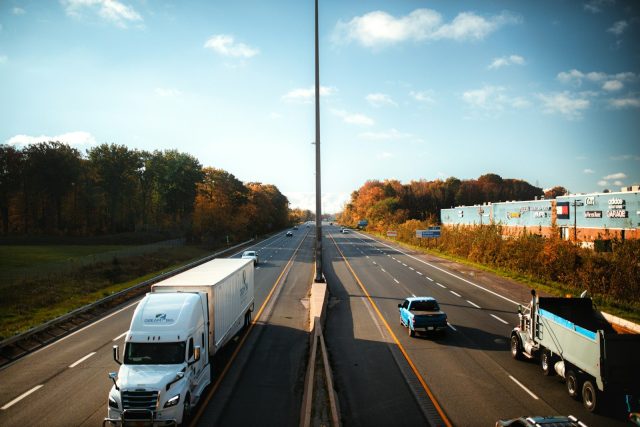
Defensive driving cannot save you from a fully loaded semi that misjudges your car’s position. That’s the uncomfortable truth behind most serious truck crashes on interstates and state highways. The advice you’ve heard your whole life, check your mirrors, leave space, stay out of blind spots, is real advice, and it does help. It just wasn’t designed for the physics of an 80,000-pound vehicle traveling at highway speed, and it doesn’t tell you what to do once something has already gone wrong.
So the useful question isn’t how to drive better around trucks. It’s what actually protects you when the safe habits run out.
The Problem Isn’t Bad Driving, It’s Mismatched Physics
A passenger car and a commercial truck are not two versions of the same thing. They’re different machines with different stopping distances, different sight lines, and different failure modes. A car braking hard stops in a few car lengths. A fully loaded tractor-trailer braking hard needs the length of a football field, sometimes more, depending on grade, weather, and tire condition.
That gap in physics is where most serious crashes happen. The car driver did nothing dramatically wrong. The truck driver may not have either. But a small error, a slow merge, a lane drift, a delayed reaction, becomes something a passenger vehicle cannot absorb.
And the numbers aren’t small. FMCSA crash data shows thousands of people killed and well over a hundred thousand injured every year in crashes involving large trucks in the United States. Those aren’t fender benders. They end careers, empty savings accounts, and change families permanently.
Why “Just Drive Defensively” Falls Short
Defensive driving is a mindset built around what the driver can control. That’s a useful frame for most of what happens on the road. But truck crashes are often shaped by things happening well before the car ever pulls onto the highway.
- Hours behind the wheel. Fatigue shows up again and again in commercial trucking crash reports. A driver pushing to finish a route on time may still be legal on paper and dangerously tired in practice.
- Maintenance shortcuts. Brakes, tires, and coupling equipment fail when they aren’t inspected on schedule. Those failures don’t announce themselves before they happen.
- Load and balance. A trailer loaded wrong can jackknife or roll in a turn that a properly loaded one would handle without a thought.
- Pressure from the top. Dispatch schedules, delivery windows, and pay-by-the-mile structures can push drivers to make choices a salaried employee wouldn’t.
None of that is visible from the car next to the truck. You can drive perfectly and still be in the wrong lane at the wrong second. That’s not a character flaw in defensive driving. It’s a limit of what any individual road habit can do against a system-level problem.
What Actually Protects You Before a Crash
The better mental model is layered. Defensive habits are one layer. The others are about knowing where risk concentrates and how to move through it.
- Stay out of the squeeze zones. The area beside a truck’s cab, directly behind the trailer, and immediately in front of the tractor are the hardest places for a driver to see you. Pass with intent, don’t linger.
- Read the trailer, not the cab. A trailer starts drifting or leaning before a crash. If you see sway, tire smoke, or a shifting load, back off and give the truck room to correct.
- Treat on-ramps as merge negotiations. A truck can’t dodge you at highway speed. Adjust your speed to slot in cleanly rather than assuming the truck will make space.
- Respect weather multipliers. Rain, wind, and ice change a truck’s handling more than a car’s. Give more distance in bad conditions, not less.
What Actually Protects You After a Crash
The moments after a truck crash matter in a way most drivers don’t understand until they’re in one. Evidence disappears fast. Trucking companies often have rapid response teams on scene within hours, sometimes before the injured driver has left the emergency room. Those teams aren’t there to help you.
If you’re physically able, get photos of the scene, the trucking company’s name and DOT number on the cab, and the names of any witnesses. Get medical attention even if you feel fine, because soft tissue and head injuries often show up later. And be careful about early conversations with insurance adjusters, who are trained to lock in a version of events before you know what your injuries actually are.
This is also the point where getting a truck accident attorney involved changes what evidence gets preserved. Federal rules give trucking companies a limited window to hold onto logbooks, electronic control module data, and maintenance records. After that window, records can be destroyed on a normal retention schedule. A written preservation letter, sent quickly, is often the difference between a case with proof and a case built on memory.
The Layer Most Drivers Skip
Knowing how the industry works is its own layer of protection. Trucking is regulated at the federal level, and those regulations exist because the failure modes are known. Hours-of-service limits, drug and alcohol testing, mandatory inspections, and electronic logging devices are all responses to specific patterns of crashes.
You don’t have to memorize the regulations. But knowing they exist, and knowing that a violation of one of them is often the real cause of a crash that looks like a simple lane change, changes how you think about what happened.
It’s also why cases involving commercial trucks are handled differently than ordinary car crashes. The defendant isn’t a single driver. It’s a company, an insurer, and sometimes a shipper or a maintenance contractor, each with their own lawyers and their own reasons to point at someone else.
Defensive driving is worth doing. It’s not the whole answer. The rest is knowing where the risk really lives, what the industry is doing behind the wheel, and what to do in the hours and days after something goes wrong. That’s the layered version of safety, and it holds up when the physics stop cooperating.