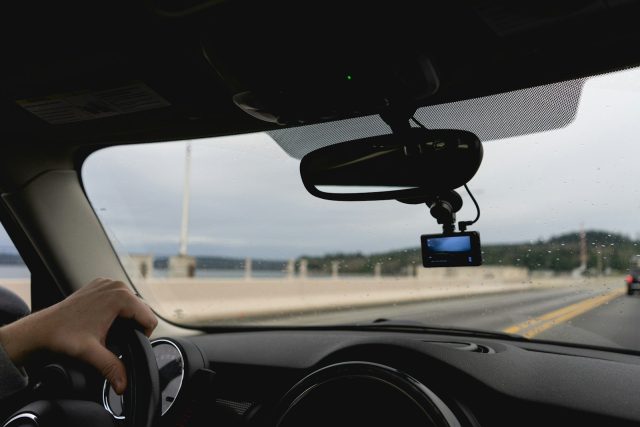
Does your dash cam footage help you if you get rear-ended? Short answer: yes, more than almost any other piece of evidence you’ll have in the first hour after the crash, as long as the file is still on the card by the time anyone thinks to ask for it.
Rear-end crashes are the case type where a few seconds of video decides everything. The other driver says you stopped short. You say they were tailgating and looking at their phone. Without footage, that’s a swearing contest the insurance adjuster settles with a rule of thumb.
With footage, it becomes a factual question with a factual answer. The wrinkle most drivers don’t consider until it matters is whether their camera preserved those seconds or wrote over them somewhere between the crash and the driveway.
What Does Continuous Loop Recording Actually Do?
Most consumer dash cams don’t record one long file. They record in short segments, usually a couple of minutes each, and once the memory card fills up, the camera starts overwriting the oldest clip with the newest one. Cobra’s own product explainer describes the mechanic in plain terms: new footage replaces old footage once the card is full, and clips flagged by the G-sensor get locked so they survive the loop.
That G-sensor lock is the part that matters after a rear-end hit. A hard enough jolt trips the accelerometer, the camera walls off the surrounding clip, and that segment stops being eligible for overwrite. If the impact was light, or the sensor threshold was set conservatively, the lock may never fire. In that case, the clip you need is on a countdown from the moment the card keeps rolling.
Why Is a Rear-End Case So Often a He-Said-She-Said?
Rear-end crashes look simple on paper. The car behind is presumed at fault in most jurisdictions, and adjusters process them fast. In practice, the driver who got hit often has to fight a counter-story: brake-checking, a sudden lane change, a phantom stop for nothing. Those defenses are cheap to raise and hard to disprove without a record of the seconds before impact.
That’s why the footage carries so much weight. A firm that handles these claims, like the personal injury team at Conlon Tarker, will tell you the fight in a rear-end case is rarely about who hit whom. The fight is about following distance, speed, eyes-on-road, and whether the lead driver did anything sudden. Video answers all four in a way a diagram on a police report cannot.
How Fast Can Your Footage Disappear?
Faster than most drivers expect. A 32 GB card on a 1080p camera can cycle through in a matter of hours of driving, sometimes less on higher-resolution units. If the G-sensor didn’t lock the clip, and you drove home from the scene or ran errands the next day, the crash may already be gone.
The fix? Treat the card like evidence the moment the airbags settle.
- Power down the camera. Turning the unit off keeps the loop from advancing, which helps protect the crash segment from being overwritten on your next trip.
- Pull the memory card. Eject it at the scene if it’s safe to do so, or as soon as you’re home, and set it aside so no one records over it by accident.
- Copy the files off. Move the full contents of the card to a computer or cloud drive without editing or renaming anything, so the original timestamps stay intact.
- Note the clip you need. Write down the filename covering the minutes before, during, and after impact, and keep that note with the copies.
- Hand it to a lawyer before you hand it to an adjuster. Once someone else has the file, you lose control of how it’s framed, and the sequence in which it gets shared can matter.
Will an Adjuster or a Court Actually Care?
Insurers now routinely accept dash cam clips in first-party and third-party claims, and video evidence tends to shorten the fight because it removes the room for creative retelling. A Nexar analysis of commercial dashcam programs found that fleets using camera-based driver feedback saw incidents drop sharply and cost far less to resolve when they did occur.
Courts are generally receptive too, subject to the usual rules of evidence. The footage has to be relevant, authentic, and unaltered, and the person offering it has to say where it came from and confirm that nobody tampered with it. That’s why the copy-and-preserve step matters more than any settings menu on the camera itself.
What to Do in the First Hour After a Rear-End Hit
A dash cam is a witness that doesn’t get nervous, doesn’t misremember, and doesn’t change its story on cross-examination. It’s also a witness with a short memory if nobody bothers to write down what it saw.
That’s the tradeoff with continuous-loop recording: the technology can preserve the clearest account of a crash while simultaneously putting that account on a clock. After a rear-end collision, saving the footage should be treated like photographing the damage or exchanging insurance information.
The camera may have captured exactly what happened, but only if you make sure it doesn’t forget.