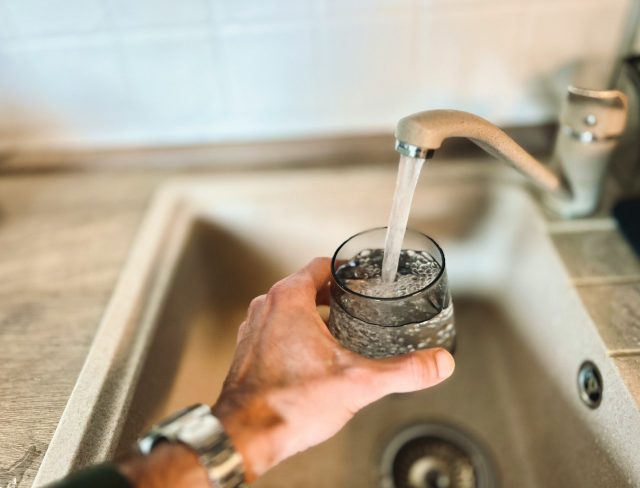
When your tap water suddenly tastes earthy, musty, or a little like a lake bottom, most people assume something broke at the treatment plant. The opposite is usually true. The water is almost likely still safe and still within every regulated limit, and the taste you’re picking up is a signal the plant is working hard on a source that got harder to treat this season.
Two tiny molecules are the culprits, and your nose can detect them at concentrations so small they barely qualify as present. Here’s how they end up in your glass, what your utility can and can’t do about them, and why the taste shifts at the same time every year.
Reservoirs Warm Up and the Microbes Wake Up
The story starts weeks before anyone pours a funny-tasting glass. Surface reservoirs sit in the sun through late spring and early summer. The upper layer warms up, nutrients from runoff settle in, and the conditions start favoring cyanobacteria and certain filamentous bacteria that have been present at low levels all along.
As those organisms multiply, two of their metabolic byproducts build up in the water column: geosmin and 2-methylisoborneol, usually written as 2-MIB. Neither one is a toxin. Both are intensely smelly. Once reservoir levels drop later in the season, concentrations climb faster, because the same amount of compound is now dissolved in less water.
Utilities that pull from deep groundwater rarely deal with this. Utilities that draw from lakes, rivers, and open reservoirs see it most years, and the arrival window is predictable enough that operators start sampling for it well before any customer tastes a thing.
Two Molecules Slip Past Conventional Treatment
Geosmin and 2-MIB are small, stable, and dissolved. That combination is a headache.
Conventional coagulation, settling, and filtration are built to remove particles and pathogens, not trace organic molecules that behave like a dye in solution. The filters catch the cyanobacteria themselves, but the flavor compounds slip right through.
Human noses, meanwhile, are absurdly good at finding them. People routinely report an earthy or musty taste when the compounds are present at only a few parts per trillion, one of the lowest detection thresholds for any odorant in nature. You can be tasting something measured in a handful of molecules per trillion water molecules and still be dead certain it’s there.
That mismatch between what people can taste and what standard treatment can remove is why summer complaints spike even at utilities that are hitting every regulated target. Managing shifting raw-water chemistry through a bloom is why many utilities work with specialty chemical partners who can tune treatment programs to how a specific source is behaving week to week rather than month to month.
Operators Have a Short List of Levers at the Plant
When a bloom hits, water chemists reach for a specific toolkit. The common options:
- Powdered activated carbon. Dosed into the raw water, it adsorbs geosmin and 2-MIB before filtration. Effective, but it costs real money, and the dose has to be tuned to how intense the bloom is.
- Oxidation. Ozone or advanced oxidation processes break the compounds apart. These require capital equipment many smaller systems don’t have.
- Source switching. Some utilities blend in water from a different intake or a cleaner reservoir to dilute the problem until the bloom passes.
- Disinfectant adjustments. Shifting chlorine or chloramine dosing to keep residuals up in warmer water can change how the water tastes on its own, independent of geosmin.
None of these are free, and none are instant. Raw-water chemistry is a moving target during a bloom, and operators have to adjust in near real time as the source changes under them.
The Regulations Draw a Line Between Safety and Taste
Here’s the part that surprises people. Taste and odor sit in a different regulatory bucket than contaminants that pose a health risk. The EPA maintains secondary standards that cover aesthetic qualities like taste, color, and odor, and those standards are guidelines rather than enforceable limits. Utilities are expected to manage them, but they aren’t violating the Safe Drinking Water Act when a glass tastes musty in August.
That’s a deliberate split between what the law treats as a safety issue and what it treats as a quality-of-service issue. Geosmin and 2-MIB fall on the service side, which is why your utility can issue a cheerful bulletin acknowledging the taste while every lab result still comes back clean.
You Can Fix the Taste at Home Until the Bloom Passes
If you want to drink it anyway without the flavor, a few things work with the chemistry rather than against it:
- Chill it first. Cold water dulls your perception of both compounds. A pitcher in the fridge does more than most people expect.
- Use a carbon filter. A quality activated-carbon pitcher or faucet filter targets exactly the kind of dissolved organics causing the taste. Change the cartridge on schedule, because a loaded filter stops helping.
- Let it breathe. Pouring between containers or leaving water uncovered for a few hours releases some of the volatile compounds along with any chlorine note.
- Add acid. A squeeze of citrus masks the earthy note enough to make a glass pleasant without changing anything in the water that matters.
The bloom will fade. Reservoirs cool off, the cyanobacteria slow down, residual compound concentrations drop below your detection threshold, and the water goes back to tasting like water.